
Industry Insights
London Market Claims Reconciliation: Why It Matters and How It Can Be Fixed
London Market Claims Reconciliation: Why It Matters and How It Can Be Fixed
Claims reconciliation in the London Market is the process of matching claims bordereaux data with financial records and loss fund balances to ensure claims payments, reporting and reserves are accurate. Despite market modernisation, reconciliation across delegated authority business still relies heavily on manual processes. With $2.3bn currently held in market loss funds and new claims oversight requirements from Lloyd’s, improving reconciliation has become a critical operational priority.
For many teams operating in the London Market, claims reconciliation is a monthly operational grind. Yet with $2.3bn currently locked in market loss funds and new regulatory expectations now in force, getting reconciliation right has never mattered more.
Clean reconciliation underpins accurate claims data, controlled loss funds and proper oversight of delegated authority business. When reconciliation breaks down, the consequences are immediate: delayed payments, regulatory exposure and capital sitting idle outside the balance sheet.
The London Market is moving toward cleaner data, faster payments and stronger claims governance. But achieving that requires fixing how claims data is validated and reconciled across the market.
The Scale of the Claims Reconciliation Problem
Despite years of market modernisation, claims reconciliation in the London Market still relies heavily on manual processes.
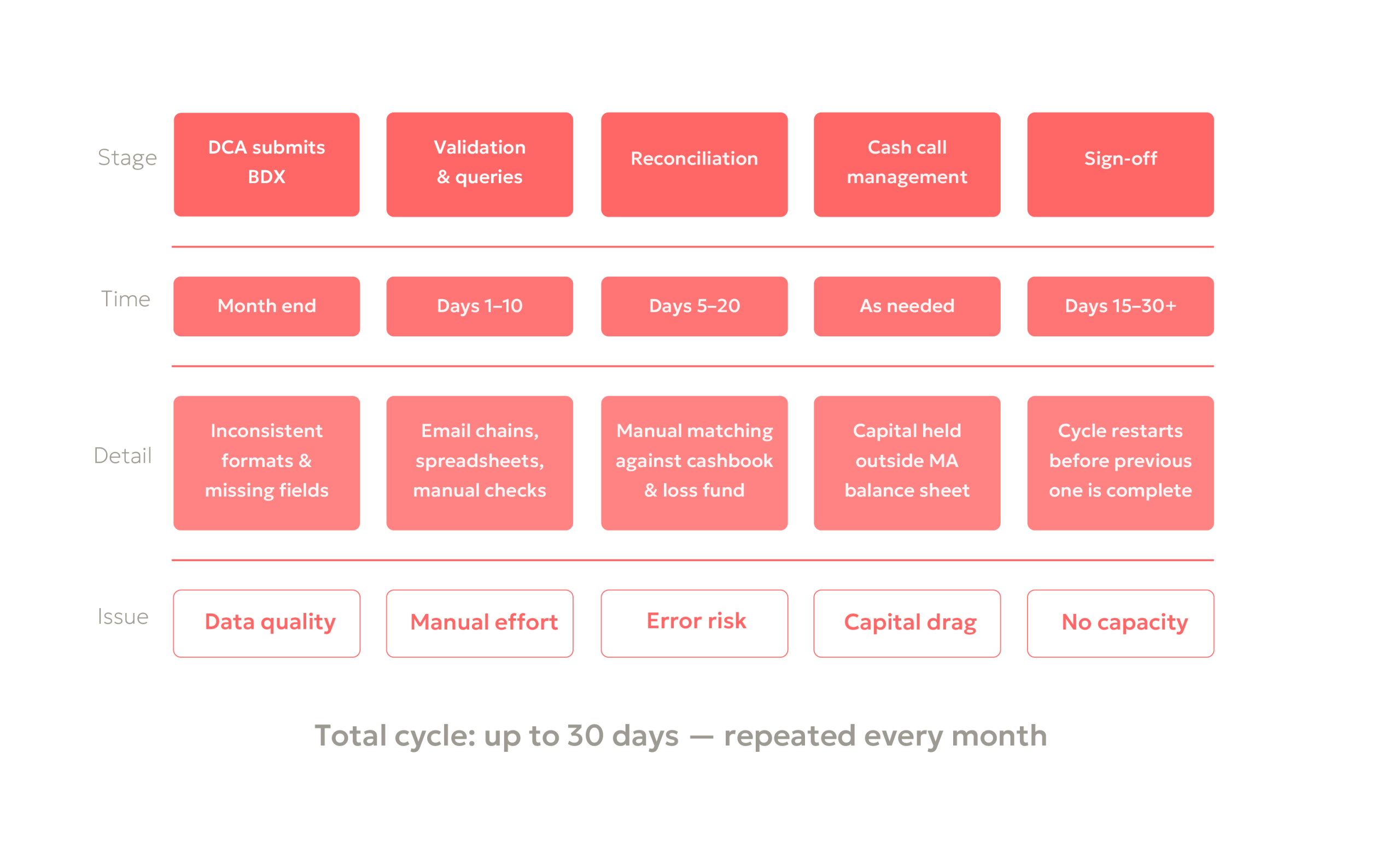
The typical monthly reconciliation cycle is operationally complex. Teams validate bordereaux files, reconcile them against loss fund balances and investigate discrepancies across multiple stakeholders. Full reconciliation and sign-off can take the majority of the month — leaving little time before the next cycle begins.
The impact is significant:
- $2.3bn currently held in market loss funds across DA business[1]
- Monthly reconciliation cycles that can take weeks to complete
- Manual bordereaux validation still common across the market
That idle capital represents both operational inefficiency and financial drag.
Why Bordereaux Errors Cause Reconciliation Problems
The root of the problem is claims data quality.
Claims bordereaux files are often:
- incomplete
- inconsistent across reporting periods
- formatted differently by each DCA
- missing key identifiers required for reconciliation
These issues force operations teams to spend significant time validating and correcting data before reconciliation can even begin.
As data requirements increase across the market, these manual fixes become harder to sustain.
The Impact of Lloyd’s Faster Claims Payment (FCP)
The Faster Claims Payment (FCP) service places greater emphasis on accurate and timely claims data. FCP provides the infrastructure that allows claims funds to be managed and paid more efficiently across delegated authority business. However, the service depends on clean, validated bordereaux data.
If the underlying data is inconsistent or incomplete, reconciliation still becomes a manual exercise — undermining the efficiency the infrastructure was designed to deliver.
Why Claims Oversight Became a Lloyd’s Hurdle Principle
Regulatory pressure around claims governance is increasing. From 1 January 2026, Lloyd’s elevated Claims Management to a hurdle principle within its Principles Based Oversight framework.[3]
This means:
- Claims oversight is now a core performance metric for syndicates
- A syndicate’s overall rating cannot exceed its lowest claims rating
For delegated authority business, managing agents must demonstrate ongoing oversight of claims handled by DCAs operating at arm’s length.
That oversight depends on accurate, timely claims data — particularly through claims bordereaux submissions.
In other words, clean bordereaux data is no longer operational infrastructure — it is regulatory infrastructure.
How Automation Fixes Claims Bordereaux Reconciliation
Modern reconciliation platforms automate the steps that currently consume operational teams:- Bordereaux validation — automatically checking files for missing fields, inconsistencies and structural issues
- Claims reconciliation — matching claims data against cashbook and loss fund positions
- Exception identification — highlighting discrepancies requiring investigation
- Operational dashboards — providing real-time visibility across claims portfolios
How Voult Automates Claims Reconciliation
Voult automates claims bordereaux validation and FCP reconciliation for managing agents, MGAs and coverholders — fitting into existing systems and workflows.
In practice this means:
Automated bordereaux validation
Detailed checks on every claims bordereaux file completed in under 20 seconds, catching errors before they enter reconciliation workflows.
Automated reconciliation
Claims data is systematically reconciled against cashbook and loss fund positions, eliminating manual matching processes.
Operational efficiency
Data is corrected at source by DCAs, reducing duplication and giving managing agents assurance on the quality of data used for reporting.
Real-time oversight dashboards
KPI visibility across the claims portfolio provides managing agents with the oversight required under the hurdle principle.
Integration with Vitesse
Automated transmission of data enables faster reconciliation and alignment with FCP workflows.
Voult reduces bordereaux processing times by up to 90% while significantly reducing processing errors. For teams currently spending weeks each month on manual reconciliation, that time goes back to oversight and governance — where it belongs.
The Direction of Travel for the London Market
The London Market is moving toward:- cleaner data
- faster claims payments
- stronger oversight of delegated authority business
Achieving that shift requires moving away from manual bordereaux validation and reconciliation processes.
Automation allows the market to meet new regulatory expectations while freeing operational teams from repetitive reconciliation work.
See Voult in Action
See how automated claims bordereaux validation and reconciliation works in practice. Book a demo today.